Showing posts with label magic realism. Show all posts

Saturday, 24 April 2021

Bird Fanciers' Lung...


The doctors of Luckycola were overrun with nervous mothers and their asthmatic school children, their breathing thinned and made ragged by the fine feathers that fell hourly, forming
drifts of down against buildings and light-posts. That winter,
when thousands of elderly men and women succumbed to a
pernicious type of pneumonia, the crisis was attributed to a rare
respiratory condition, known euphemistically to specialists as
Bird Fanciers’ Lung.


At the height of the pneumonia epidemic, President Ongresowa had stood in a white drift on the steps outside the Sunshine Circus and had spoken to the people of Incognita. It had
always been thus, the President had pointed out. The country of
Incognita had always been at risk of being over-run by migratory
birds. The last of the gaps in the great wall would finally be
filled in, he told the people, and a million square metres of
flight-proof netting would temporarily protect the eastern seaboard from the plague of predatory birds.

Saturday, 23 March 2019

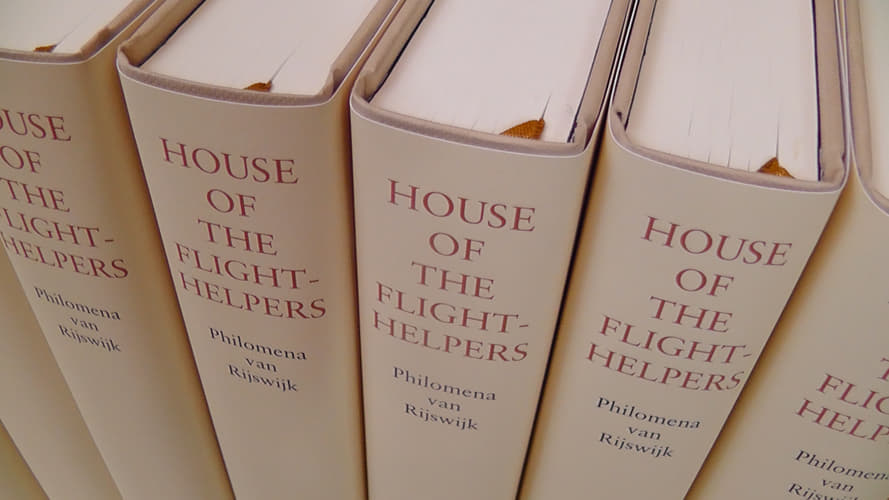
House of the Flight-helpers

"The people of Incognita have walled themselves in..."

House of the Flight-helpers by Tasmanian author Philomena van Rijswijk is a strange and satirical narrative, a mythological mosaic of horrors, feather phobias, dead saints, clay flutes, terrible birds, Border Monkeys, forbidden zones and unsettling forebodings. It casts the reader into the future, a future left trammelled by the glacial passage of xenophobia and exclusion. It is a parable of sorts, and considers the biggest questions and insecurities of our age, one of the most poignant of which is: when we exclude the outsider, are we, in fact, imprisoning and impoverishing ourselves?


Philomena van Rijswijk lives in Tasmania, the ‘south island’ of Australia. Her last novel, The World as a Clock-face, was published by Penguin. Her poems and short stories have been published in collections and literary journals in Australia, Ireland and India. The author’s work was included in Best Australian Stories 2002 (Black Inc) and Best Australian Poetry 2005 (UQP). Some of her stories have been translated into Hindi by Dr Aruna Sitesh and published in Delhi. Her poetry collection, Bread of the Lost, was published by Walleah Press in 2013. In 2016, she was awarded the Masterton District Fellowship, spending three weeks at the New Zealand Pacific Studio at Mt Bruce in New Zealand. Philomena lives alone with her two budgerigars, Neftali and Mathilde, in the south east of the island.  She has five adult children and eight grandchildren.


Cover image by Watanabe Shotei aka Watanabe Seitei (1851–1918)Tartarus Press UK

Thursday, 29 June 2017

The Bishop, the Gypsy and the Dancing Bear


In fact, The Bishop, the Gypsy and the Dancing Bear is not a story about bears at all, but a story about mankind.  It is a story about borders, migration and freedom.  No doubt, there are now many novels about the concepts of refuge and asylum, but this novel casts the reader into the future, a future left trammelled by the passage of xenophobia and exclusion.  It is a parable, of sorts, not only relevant in this country (thinly disguised as the country of Incognita), but to the developed world at large.  It considers the biggest questions and insecurities of our age, one of the most poignant being this one:  When we exclude the outsider, are we, in fact, imprisoning and impoverishing ourselves? 


Philomena van Rijswijk is a Tasmanian novelist, poet and writer of short stories.  She has been compared to both Gabriel Garcia Marquez and Ursula le Guin.  Her most recent novel, The World as a Clockface, was published by Penguin Books Australia in 2001.

Saturday, 24 June 2017

The Bishop, the Gypsy and the Dancing Bear


“Reminiscing over his breakfast of grapefruit, the bishop found it almost impossible to believe that he remembered such a strange phenomenon as a gypsy boy and a dancing bear.  […]Surely, that was not in his lifetime?

It was, perhaps, in another century, was it not? the poor old bishop worried.  Was it in a dream that the boy bear-trainer had leaned toward him and whispered: His name is Veshengo.  It means man of the forest.  He is the last of the wild bears.”

Friday, 16 June 2017

Magic Realism Writers from Around the Word...I'm in there!!!

Carlos Acosta - Cuba
Chingiz Aitmatov - Russian Kyrgyzstani
Michal Ajvaz  - Czech 
Rabih Alameddine - Lebananese 
Kathleen Alcala - Mexican American (Jewish)
Sherman Alexie - First Nation American
Dean Francis Alfar - Filipino
Edwar Al-Kharrat - Egyptian
Ibrahim al-Koni - Libyan
Isabel Allende - Chilean
Jorge Amado - Brazilian
Rudolfo Anayo - Chicano American
Mario De Andrade - Brazilian
Marie Arana - Peruvian
Reinaldo Arenas - Cuban
Miguel Angel Asturias - Guatemalan
Bernardo Atxaga - Spanish Basque
Marcel Ayme - French
Fadi Azzam - Syrian
Chitra Banejee Divakaruni - Indian American
Michel Basilieres - Canadian
Bertice Berry - African American
Ingrid Betancourt - French Argentinian
Lauren Beukes - South African
Maxim Biller - German (born in Czech Republic)
Adam Bodor  - Transylvanian Hungarian
Jorge Luis Borges - Argentinian
Hafid Bouazza - Moroccan Dutch
Andre Brink - South African
Italo Calvino - Italian
Cuca Canals  - Spanish
James Canon - Columbian
Alejo Carpentier - Cuban
Mircea Cartarescu - Rumanian
Adolfo Bioy Casares - Argentinian
Carlos Castaneda - Peruvian-born American
Rosario Castellanos - Mexican
Ana Castillo - Mexican-American Chicano
Joao Cerqueira - Portuguese
Patrik Chamoiseau - French Martinique
Pia Chaudhury - Indian British
Yi Chung-jun - South Korean
Paul Coelho - Brazilian
Julio Cortazar - Argentinian
Mia Couto - Mozambiquan
Marie Darrieussecq - French
Junot Diaz - Dominican
Chitra Banerjee Divakaruni - Indian American
Jose Donoso - Chilean
Kerstin Ekman - Swedish
Mikhail Elizarov  - Russian
Louise Erdrich - Native American
Mario Amparo Escandon - Mexican American
Laura Esquivel - Mexican
Heinz Insu Fenkl - Korean American
Carlos Fuentes - Mexican 
Romulo Gallegos - Venezuala
Cristina Garcia - Cuban
Elena Garro - Mexican
Aleksandar Gatalica - Serbian
Zulfikar Ghose - Pakistani American
Gogol - Russian
Hiromi Goto - Japanese Canadian
Gunter Grass - German
Jiri Grusa - Czech
Xiaolu Guo - Chinese British
Suentra Gupta - Indian
Abdulrazak Gurnah - Tanzanian
Katherina Hagena - German
Knut Hamsun - Norwegian
Thomas Olde Heuvelt - Dutch
Daniela Hodrova - Czech
Peter Hoeg - Danish
Tess Uriza Holthe - Filipino American
Nalo Hopkinson  - Jamaican Canadian
Witi Ihimaera - New Zealand (Maori)
G Cabrera Infante - Cuban
Anosh Irani - Indian 
Hamid Ismailov - Uzbek
Mette Jakobsen - Danish
Pai Ilmari Jaaskelainen - Finish
Tahar Ben Jelloun - Moroccan
Cynthia Kadohata - Japanese American
Franz Kafka - Czech 
Jonas Karlsson - Swedish
Raj Kamal Jha - Indian
Hiromi Kawakami - Japanese
Daniel Kehlmann - German and Austrian
Porochist Khakpour - Iranian American
Daniil Kharms - Russian
Thomas King - American Canadian 
Laszlo Krasnahorkai - Hungarian
Guus Kuijer - Dutch
Milan Kundera - Czech
Eka Kurniawan - Indonesian
Antoine Laurain  - French
Halldor Laxness - Icelandic
Peter Tieryas Liu - Asian American
Jose Lezama Lima - Cuban
Mario Vargas Llosa - Peruvian
Rani Manicka - Malaysian
Gabriel Garcia Marquez - Columbian
Carole Martinez - French
Tomas Eloy Martinez - Argentinian
Rohinton Mistry - Indian-born Canadian
Mayra Montero - Cuban
Shani Mootoo - born in Dublin, raised in Trinidad, lives in Canada 
Pat Mora - Mexican American
Harry Mulisch - Dutch
Haruki Murakami - Japanese
Nabokov - Russian
Gina Barkhordar Nahai - Jewish Iranian
Bahiyyih Nakhjavani - Born Iranian,  grew up in Uganda and now lives in France
Andres Neuman - Spanish Argentinian
Tea Obreht - Bosniak Serbian
Silvina Ocampo - Argentinian
Kenzaburo Oe - Japanese
Nnedi Okorafor - Nigerian American
Ben Okri - Nigerian
Helen Oyeyemi - Nigerian British
Vikram Paralkar - Indian American
Nii Ayikwei Parkes - Ghanaian
Shahrnush Parsipur - Iranian
Milorad Pavic - Serbian
Victor Pelevin - Russian
Miroslav Penkov - Bulgarian
Ludmilla Petrusevskaya - Russian
Stepan Pisakhov - Russian
Salvador Plascencia - Mexican American
Manuel Puig - Argentinian
Christopher Ransmayr - Austrian
Dolores Redondo - Spanish Basque
Darcy Ribeiro - Brazilian
Philomena van Rijswijk - Australia
Manuel Rivas - Spanish
Carolina De Robertis - Uraguayan - American
Eden Robinson  - First Nation Canadian
Arundhati Roy - Indian
Juan Rulfo - Mexico
Salman Rushdie - British Indian
Preeta Samarasan - Malaysian
Jose Saramago  - Portuguese
Patricia Schonstein - South African
Ekaterina Sedia - Russian
Erick Setiawan - Indonesian
Elif Shafak - Turkish
Ryhaan Shah - Indo-Guyanese
Meir Shalev - Israeli
Anton Shammas - Palestinian
Siddharth Dhanvant Shanghvi - Indian
Leslie Marmon Silko - First Nation American
Sjon - Icelandic
Sasha Sokolov - Russian
Manil Suri - Indian American
Noemi Szecsi - Hungarian
Antonio Tabucchi - Italian
Paco Ignacio Taibo - Mexican
Ngugi Na Thiongo - Kenyan
Tim Tingle - First Nation American
Tatyana Tolstaya - Russian
Amos Tutuola - Nigerian
Luis Alberto Urrea - Mexican American
Luis Valenzuela - Argentinian
Carl Johan Vallgren - Swedish
Miklos Vamos - Hungarian
Vassilis Vassilikos - Greek
Alfredi Vea - Mexican Yaqui Filipino American
Carlos Velasquez - Mexican
Juan Pablo Villalobos - Mexican
Eugene Vodolazkin  - Russian
Katern Tei Yamashita - Japanese American
Mo Yan - Chinese
Tiphanie Yanique - Virgin Islander
Yorgi Yatromanolakis - Greek 
Banana Yoshimoto - Japanese
Serhiy Zhadan - Ukrainian
Yousef Ziedan - Egyptian

Tomorrow I will bring you a video about Russian magic realism.The Link to the Magic Realism blog

Friday, 16 October 2015

Doña Erudita del Maldiciòn de la Broma de la Puta-madré


Notas Biograficales:- Doña Erudita was born  from the union of a leprous whore and a floating saint, San Ernesto de Puta-madré.  On that accursed wedding day, the whore’s own father repaired to the village outhouse, dowsed himself in tequila and set himself on fire.  All that was left of him was a pair of purple glass eye-lids, handed down to him from a famous glass-maker and optical prosthetist from Seville.  Little Erudita was born into the hands of her father some fourteen months later, after a prolonged pregnancy.  Indeed, the local midwife had claimed that she had heard the infant speaking Castilian from inside her mother’s rabid womb.  At the age of three years, the little girl started writing poetry, which she said she heard when she put her head inside the stone holy water font at the church of St Alfonsina del Mar.  In later years, when a fireworks accident (an exploding iguana) caused Erudita to become stone deaf, she started deriving her poemas from the patterns that the geckos drew with their slime on the steps of the Jardin Botanicál de Rey in  Xoacotquetloaxcs.  On being deposed as a saint, Ernesto emigrated to the Antipodean backwater known as The Mallee, where, with three black pigs named Chancho, Tocino and Chorizo, he set up a lucrative magic mushroom-hunting business.