
Thursday, 25 July 2019
President for Life
In the early days, it had not been too difficult to teach the children the forbidden word, bird, to tell them the diluted story of the little clay flute, and to recall simple anecdotes from the book called Walden. But, over the years, so many things had changed, especially after President Ongresowa had been elected President for life. By that time, most children were born underweight, their intellectual growth stunted from lack of light and from malnutrition. Most of the population relied on Havnotz bread for the bulk of their diet, which was made from leaves, grass and corn husks imported from the Scenic Route and beyond. President Ongresowa had demanded that even the smallest school should put aside the time every day for the singing of patriotic songs, dancing of stylised folk dances, and forming of human pyramids. The children had little energy for the acrobatics and flash-card demonstrations demanded by the President. Every day, after lunch break, Miss Fletcher coaxed them to rest their heads on their desks, and to close their eyes. While the children’s eyes were closed, she told them stories. Miss Fletcher understood that she must never refer to a time before the Wall or a place outside the Flightproof Netting, for the President insisted that the children must grow up without a knowledge of either. - Excerpt from "House of the Flight-helpers", Tartarus Press UK

Thursday, 4 July 2019
The Walking of the Dolls
(Excerpt from "House of the Flight-helpers" by Philomena van Rijswijk, Tartarus Press UK)

Once a year, the main street of Grenzgebiet was closed to wheeled traffic, such as trucks and carts, and the tall dolls atop their skilfully wielded stilts, would lead a parade through the town. Some of the dolls had faces as smooth and as white as porcelain, with kohled almond-shaped eyes and ridiculously long orange wigs. Others had their faces covered with leather balaclavas, their eyes and mouths suggested behind irregular gashes. On their heads they wore simple goggles. There were yellow raffia skirts and tall head-dresses made from fake palmfronds; and there were long cotton trousers and sequined capes. There was an inflatable doll sitting side-saddle on a smiling inflatable moon. The inflatable doll was always the crowd’s favourite. She was called Sybil Obedience, and for many years had represented the ideal of Productive Motherhood. On the day of the doll parade, the young woman with the most children, who at the same time had put in the most hours of paid labour, was given a small resin replica of the round-eyed pneumatic character.

Once a year, the main street of Grenzgebiet was closed to wheeled traffic, such as trucks and carts, and the tall dolls atop their skilfully wielded stilts, would lead a parade through the town. Some of the dolls had faces as smooth and as white as porcelain, with kohled almond-shaped eyes and ridiculously long orange wigs. Others had their faces covered with leather balaclavas, their eyes and mouths suggested behind irregular gashes. On their heads they wore simple goggles. There were yellow raffia skirts and tall head-dresses made from fake palmfronds; and there were long cotton trousers and sequined capes. There was an inflatable doll sitting side-saddle on a smiling inflatable moon. The inflatable doll was always the crowd’s favourite. She was called Sybil Obedience, and for many years had represented the ideal of Productive Motherhood. On the day of the doll parade, the young woman with the most children, who at the same time had put in the most hours of paid labour, was given a small resin replica of the round-eyed pneumatic character.
Wirtschaftswunder Day
-Excerpt from "House of the Flight-helpers" by Philomena van Rijswijk, Tartarus Press, UK
‘People of the country of Incognita,’ he began. High above the square, Berisha Begari looked down from his perch two hundred metres above the cupola of the Sunshine Circus. ‘People of Incognita,’ the President repeated, suddenly made uneasy by the eerie stillness that now emanated from the enormous crowd. ‘I am your father,’ the President proceeded, suddenly unable to remember his prepared speech. ‘You are my children, and, like a good father, it is my sacred duty to protect my family from the Outsiders.’ The President stopped and waited. Usually, the word ‘Outsiders’ was a trigger for uproarious cheering and applause. This year, the President found himself gulping and running a finger around inside his collar, which suddenly felt too tight. The President cleared his throat. ‘ . . . from the Outsiders,’ he repeated. At last, someone in the front of the crowd raised an arm, and the President prepared himself for a cry of patriotism and nationalistic punching of the air. However, the cry that issued from the citizen was not Hurray for the President!, but a timid Boo! that echoed from one side of the square to the other, and was accompanied by the unexpected landing of an ovoid missile at the President’s feet.

‘People of the country of Incognita,’ he began. High above the square, Berisha Begari looked down from his perch two hundred metres above the cupola of the Sunshine Circus. ‘People of Incognita,’ the President repeated, suddenly made uneasy by the eerie stillness that now emanated from the enormous crowd. ‘I am your father,’ the President proceeded, suddenly unable to remember his prepared speech. ‘You are my children, and, like a good father, it is my sacred duty to protect my family from the Outsiders.’ The President stopped and waited. Usually, the word ‘Outsiders’ was a trigger for uproarious cheering and applause. This year, the President found himself gulping and running a finger around inside his collar, which suddenly felt too tight. The President cleared his throat. ‘ . . . from the Outsiders,’ he repeated. At last, someone in the front of the crowd raised an arm, and the President prepared himself for a cry of patriotism and nationalistic punching of the air. However, the cry that issued from the citizen was not Hurray for the President!, but a timid Boo! that echoed from one side of the square to the other, and was accompanied by the unexpected landing of an ovoid missile at the President’s feet.

An astonishing book...Review by Clare Rhoden
House of the Flight Helpers by Philomena van Rijswijk Tartarus Press Review by Clare Rhoden (Aurealis Magazine)
House of the Flight Helpers is a meditation on the present and the future it forebodes. In the dystopian land of Incognita, fear and loathing disrupt the natural order. Cowering inside Luckycola city, everyone lives in the shadow of the Great Wall, a barrier erected to keep out birds. Every feather that slips in invites panic: city folk suffer from a manic phobia of everything avian. Overhead, bird-proof netting separates the city from the dangerous sky. Days are dimmed and a permanent seasonal disorder prevails. But the servants of the President for Life ensure no citizen shows sadness. Oxymoronic Cheerful Federators, cold and brutal as the Stasi or the SS, prey on the citizens. Into this heartless setting, van Rijswijk introduces a swathe of pathetic but interesting characters, from Juana in the mental hospital to Honeysuckle Rose, a child plucked from home and thrust into an orphanage after her sister’s arrest. The multitude of stories within this novel produces a dense read that needs time and reflection. The convoluted narrative passes from scene to scene like a film panning over an entire continent, occasionally zooming in. The reader sees similar situations in different guises across the city. Fear, suspicion and self-preservation dominate. The President’s denial of history, like his institution of enforced celebrations, increases the weight of satire. House of the Flight Helpers is a concentrated critique of the 20th century and a resounding warning about the 21st. Humanity, in seeking to control life and bend it to human purpose, tramples over natural justice and beauty—here represented by birds. This book rewards slow reading and provides moments of poetic truth. Language is assured and the descriptions mesmerising. It is satire, elevated literary satire, that may frustrate the reader who desires solid stepping stones in plot and character development. An astonishing book of many merits for readers of intelligent dystopia.
*Aurealis is an Australian speculative fiction magazine published by Chimaera Publications, and is Australia's longest running small-press science-fiction and fantasy magazine. The magazine is based in Melbourne.

House of the Flight Helpers is a meditation on the present and the future it forebodes. In the dystopian land of Incognita, fear and loathing disrupt the natural order. Cowering inside Luckycola city, everyone lives in the shadow of the Great Wall, a barrier erected to keep out birds. Every feather that slips in invites panic: city folk suffer from a manic phobia of everything avian. Overhead, bird-proof netting separates the city from the dangerous sky. Days are dimmed and a permanent seasonal disorder prevails. But the servants of the President for Life ensure no citizen shows sadness. Oxymoronic Cheerful Federators, cold and brutal as the Stasi or the SS, prey on the citizens. Into this heartless setting, van Rijswijk introduces a swathe of pathetic but interesting characters, from Juana in the mental hospital to Honeysuckle Rose, a child plucked from home and thrust into an orphanage after her sister’s arrest. The multitude of stories within this novel produces a dense read that needs time and reflection. The convoluted narrative passes from scene to scene like a film panning over an entire continent, occasionally zooming in. The reader sees similar situations in different guises across the city. Fear, suspicion and self-preservation dominate. The President’s denial of history, like his institution of enforced celebrations, increases the weight of satire. House of the Flight Helpers is a concentrated critique of the 20th century and a resounding warning about the 21st. Humanity, in seeking to control life and bend it to human purpose, tramples over natural justice and beauty—here represented by birds. This book rewards slow reading and provides moments of poetic truth. Language is assured and the descriptions mesmerising. It is satire, elevated literary satire, that may frustrate the reader who desires solid stepping stones in plot and character development. An astonishing book of many merits for readers of intelligent dystopia.
*Aurealis is an Australian speculative fiction magazine published by Chimaera Publications, and is Australia's longest running small-press science-fiction and fantasy magazine. The magazine is based in Melbourne.

Wednesday, 22 May 2019
‘a palimpsest of fragments & scraps, halting tales & tortured myths…’ House of the Flight-helpers by Philomena van Rijswijk
ALONG the eastern seaboard of an unnamed continent the
authorities have built a wall. The city sprawls along the coast beaten by the
mush-brown sea, protected from outsiders or invaders and, most important of
all, from anything which flies. The city is shrouded with high nets, constantly
repaired by men who no longer fish. The nets are covered in guano and corpses,
the city below made murky by the myriad dead birds.
The citizens, the occupants of the city, have few rights and
less knowledge. They are terrified of any creature with feathers. Bird is a
banned word and the sound of gulls brings horror. At night the untouchable
caste of Cheerful Federators cleans every comb and barbule from the streets.
They sweep up anyone out past curfew: abandoned children, dying elders, the
rebel too absorbed in his graffiti to notice the dark. Such sinners are
dispatched to the orphanage, the Mental Wing or the subterranean Godown Prison.
They disappear and few, if any, ever return.
Beyond the city wall stretches the terrible Inland, a
massive desert of heat and sand, though at its very centre is rumoured to be a
place of sweetness and calm. Predators and vermin roam out there, to be avoided
at all costs.
Of course, all walls look different from the other side. The
long construction bars the way to the sea for the roaming Camel Wallahs, Blue
Wallcreepers, Wallachs and other mysterious continental denizens. For them, the
loss of the cities has brought economic collapse to match environmental
destruction. Nomads wander a barren, hostile landscape collecting goods for the
teeming markets and shanty towns lined against the outside, the downside, the
unknown side of the wall.
Some find or stumble upon ways to penetrate the wall and
face the dangers of the outside. (No-one is coming the other way, into the
lucky privileges of the chosen few.) A message is carried: it is cold…we have
no blankets. All routes are circuitous, perplexing, accompanied by fable and
myth. Bird-tracks in the dust are as legible, as meaningful, as human words.
Eventually, inevitably, the wall is breached. The tyrant falls and a young,
wise, enigmatic man tears up that mantle to begin again, to make something different.
A life or a time
looks simple when you leave out the details[1]
Don’t let my description suggest that this is a linear
novel. It is a series of fragments, pieces of news from nowhere. The city finds
echoes in the streets of Hav of the Myrmidons; Inland is the antonym of Le
Guin’s Valley. Stories come and go, meander through the dried wadis, in and out
of sad villages and past infants left to starve until adopted by birds. A child
plays in a gutter till she is swept away, reunited with her lost sister fifty
tales later after circumnavigations and drowning.
[1] Ursula Le Guin The Birthday of the World and Other
Stories
(Cont. next column)
House of the Flight-helpers is a palimpsest of fragments and
scraps, halting tales and tortured myths. Half-remembered stories, which you,
the reader, rework so that when this character or that symbol re-emerges you
are no longer sure of its history or freight. The form mirrors a fractured
place, a land of erasure and retelling, broken by its mysterious past.
Reading the book, itself a delightful object, is like
following the news of a distant war, hard and unrelenting. In many ways, it is
indeed the telling of the aftermath of conflict, what is left when the men ride
away to die under black flags, when the fish no longer come and the ravaged
soil provides no crops. It is a long
time before we find any possibility of salvation.
Van Rijswijk manages the complexity of dystopia beautifully.
Each page bristles with unlikely details, strange insights into the horror
within and outside the city colliding with beauty, with trust and the
possibility of connection. Sentences carry great weight, repaying close reading
to quarry out the references and possibilities they contain.
On recovering their ability to use the word blue, the people
of the valley of broken dreams became ‘free to remark on the ethereal hue of an
infant’s eyes, and the three most tenuous emotions – joy, nostalgia and sadness
– ran free and unfettered in the veins and arteries of the restored men and
women of that blessed place.’
La esperanza es lo último que se pierde[1]
In the end, the ducks return. The lake of stillness at the
heart of things is in the city itself. ‘Mankind’s endless and insatiable need
for some glimmer of hope[2]’ feeds the possibility of change. The horrifying
reality van Rijswijk imposes upon us is the uncertainty of permanence. We are
left unsure: if solutions are only ever temporary, maybe hope is condemned to
be illusory,
We, the readers, inevitably know that here in our present
world, walls are being rebuilt and continents re-partitioned. Resource wars
driven by climate change are underway. These present problems are already
daunting. The House of the Flight Helpers shows that after the apocalypse we
will continue to hope. The author suggests that there is a horror in optimism;
in the face of knowledge, hope itself is torture. Even so, the terror remains
that hope will die and not return.
[1] Spanish proverb, translated as hope dies last.
[2] P 281, first edition
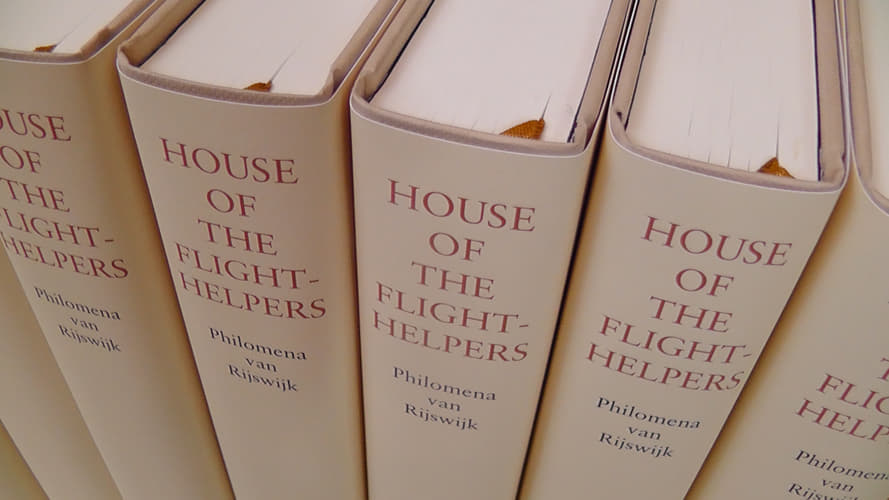
House of the Flight-helpers by Philomena van Rijswijk has
been published by independent UK publisher Tartarus Press as a sewn hardback in
a limited edition of 300 copies; 310 pages, ISBN 978-1-912586-09-7, price £35
inc. p&p worldwide.
Reviewer Sarah Tanburn is a writer and sailor, anchored in
South Wales. Her writing has appeared in Nowhere Magazine, Snapshots of
History, A River of Stones and various ‘zines. She is writing a novel about
revolutions and the sea, and working towards a doctorate in creative writing
from the University of Swansea. She has been shortlisted for the 2019 Rheidol
Prize.
www.sarahtanburn.wordpress.com
www.sailingtoantarctica.com
Follow Horla on Twitter@HorlaHorror

Monday, 20 May 2019

Saturday, 23 March 2019
House of the Flight-helpers
"The people of Incognita have walled themselves in..."
House of the Flight-helpers by Tasmanian author Philomena van Rijswijk is a strange and satirical narrative, a mythological mosaic of horrors, feather phobias, dead saints, clay flutes, terrible birds, Border Monkeys, forbidden zones and unsettling forebodings. It casts the reader into the future, a future left trammelled by the glacial passage of xenophobia and exclusion. It is a parable of sorts, and considers the biggest questions and insecurities of our age, one of the most poignant of which is: when we exclude the outsider, are we, in fact, imprisoning and impoverishing ourselves?
Philomena van Rijswijk lives in Tasmania, the ‘south island’ of Australia. Her last novel, The World as a Clock-face, was published by Penguin. Her poems and short stories have been published in collections and literary journals in Australia, Ireland and India. The author’s work was included in Best Australian Stories 2002 (Black Inc) and Best Australian Poetry 2005 (UQP). Some of her stories have been translated into Hindi by Dr Aruna Sitesh and published in Delhi. Her poetry collection, Bread of the Lost, was published by Walleah Press in 2013. In 2016, she was awarded the Masterton District Fellowship, spending three weeks at the New Zealand Pacific Studio at Mt Bruce in New Zealand. Philomena lives alone with her two budgerigars, Neftali and Mathilde, in the south east of the island. She has five adult children and eight grandchildren.
Cover image by Watanabe Shotei aka Watanabe Seitei (1851–1918)Tartarus Press UK
Subscribe to:
Posts (Atom)